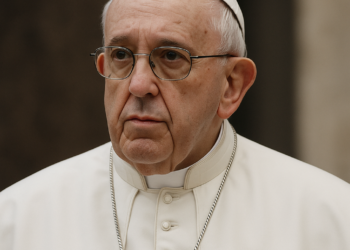
As the world learned of Pope Francis’s passing on, centuries of tradition collided with a hyperconnected present. The Vatican, a city built on ancient ritual, moved swiftly into digital realms, crafting one of the largest virtual religious gatherings in history.
From early dawn, Vatican Media orchestrated a massive, multilayered broadcast. Inside St. Peter’s Basilica, discreetly placed HD cameras captured solemn scenes: Swiss Guards in ceremonial stillness, the slow shuffle of mourners lining up to pay respects, candles trembling in the cavernous spaces under Michelangelo’s dome. Outside, drone footage offered sweeping views of the thronging crowds, framed by the iconic colonnades of Bernini.
Also Read: Pope Francis’s Digital Legacy – From Medieval Codices to Petabyte Pilgrims
Yet what unfolded wasn’t merely a traditional state farewell captured on tape. It was a meticulously engineered global transmission. Vatican engineers, working alongside partners from Akamai, AWS, and Vodafone, spun up load balancers, secondary servers, and fallback protocols to route an avalanche of traffic. The sacred moved through fiber and cloud: livestreams translated into over 40 languages, ASL and Arabic among them, simulcast not only on traditional TV networks but also on YouTube, Facebook Live, and even Twitch.
In Tokyo and Toronto, in Lagos and Seoul, millions tuned in from phones, laptops, subway screens, and projection walls. In Bogotá, the sounds of Gregorian chants threaded through public radio, while smartphone notifications pinged in prayer groups across WhatsApp and Telegram. Digital candles flickered on interactive Vatican memorial pages, each pixel a private act of mourning.
The Church’s oldest rites—silent vigils, whispered rosaries, bowed heads—suddenly lived inside a world of fiber optics and server farms. Vatican Media coordinated drone pilots, fiber technicians, translators, and moderators to ensure the solemnity reached every corner of the earth without interruption. Backup firewalls held steady against cyberattacks. CDNs cached frames of grief, minimizing latency for worshipers thousands of miles away.
Also Read: Pope Francis’s Web3 Testament: NFTs, Blockchains, and the Future of Faith
Yet amid the dazzling technical choreography, the human heart of the vigil never faded. In refugee camps, families clustered around shared screens. In villages where churches had no livestream capacity, the faithful huddled in public squares, praying in unison before a lone broadcast speaker. In suburban kitchens, teenagers lit physical candles beside their tablets.
For many, it wasn’t just about witnessing history—it was about presence, stitched together by faith and signal strength. Grief was geotagged. Devotion was livestreamed.
In the final blessing, as the camera panned wide over St. Peter’s Square, a profound silence fell across digital and physical space alike. Millions, scattered across continents and time zones, bowed their heads as one.
In the age of cloud computing and streaming platforms, death itself had become a global gathering—holy, human, and wired.